I’m embarrassed to admit this now, but the first time I ever tried a fresh cheese curd, I was not impressed.
The Tillamook Cheese Factory (since renamed Tillamook Creamery) on the Oregon coast was a frequent stop when I lived in the PNW. The self-guided tour was a fun way to see the cheesemaking process in action, and at the end, you could sample 4-5 different varieties of fresh curds. They never really appealed to me; I found them salty, rubbery, and rather bland. The real highlight of those visits was the ice cream parlor.
Fast-forward a few years. We’re living in Rapid City now, and our local Safeway carries StoneRidge Market cheese curds from Wisconsin. Knowing the Dairy State’s reputation for cheese, we decide to give them a shot, and we’re pleasantly surprised. These curds are creamier and tangier than Tillamook’s. Suddenly, I get it. I’m officially a cheese curd fan now.
But the best was yet to come.
We visited Madison in the summer of 2022—a secret prospecting trip to see if we might want to move there. Literally moments after checking into our hotel, we walked to The Old Fashioned on Capital Square for dinner. I was determined to have an authentic Wisconsin experience, which meant three things: a Friday fish fry, a Brandy Old Fashioned, and fried cheese curds.

One bite and I was hooked. These were crisp, light and airy, and perfectly cheesy. We did well in choosing The Old Fashioned, whose fried curds are consistently rated among the best in the state. Four years and many plates of curds later, theirs are still my favorite.
Today, Wisconsin is synonymous with cheese…but this wasn’t always the case.
From “America’s Breadbasket” to “America’s Dairyland”
Cheese has been around for about as long as cows have existed, but the humble curd was an accidental discovery. Thousands of years ago, our great-great-great-great-great (and on and on; you get the picture) ancestors learned that when milk was heated or turned sour, it separated into solid curds and liquid whey. Innovators that they were, the ancient Romans decided these chunks of curdled milk might make a pretty good snack, so they coated them in flour, fried them in olive oil, drizzled them with honey, and topped them with poppy seeds. The dish, called globuli, was a big hit. Can’t say I’m surprised; it sounds delicious!
By the time Wisconsin became the 30th state in 1848, we were known as “America’s Breadbasket,” producing one-sixth of the nation’s wheat. Profitable, I’m sure, but not exactly sexy. Nobody goes to the county fair and orders deep fried wheat on a stick, you know? But fate (and a little bit of greed) intervened: by the 1860s, a combination of ravenous chinch bugs and soil depletion from stubbornly relying on a single crop had pretty much wiped out all those amber waves of grain. Needing a pivot, a handful of forward-thinking farmers set their sights on New York, then the nation’s top dairy state. Wisconsin’s fertile glacial soil, abundant water, and similar climate convinced them that dairy could be just as successful here. All we needed were cows!
This moo-vement to an entirely new industry wasn’t without its challenges. Milk and butter were highly perishable, so farmers focused on cheese, which had a longer shelf life. To support their efforts, University of Wisconsin researchers developed several innovations, from round silos to Babcock testers (which measured the butterfat content in milk to determine which cows were most productive). They were aided by German, Swiss, and Scandinavian immigrants, whose knowledge of Old World cheesemaking techniques was second to none. What had once been a seasonal hobby was now a full-fledged year-round professional endeavor. Hoping to capitalize, the Wisconsin Dairyman’s Association was formed in 1872 to help market the industry and educate farmers on new dairy processes.
The invention of refrigerated railcars in the late 1860s enabled Wisconsin dairy products to be shipped all over the country. The state’s cheese quickly gained a national reputation for quality and flavor. By 1899, 90% of Wisconsin farms had dairy cows—and by 1915, Wisconsin had surpassed New York to become the nation’s top dairy state, producing more butter and cheese than anyone else. Wheat? What wheat? Wisconsin was now America’s Dairyland, a crown it holds to this day.
It’s All About the Squeak
As beloved as cheese is, curds almost seem like an afterthought—at least outside the Midwest. They’re often viewed as nothing more than a byproduct of the cheesemaking process. Technically that’s true; they are made from fresh pasteurized milk that has been cultured, coagulated, cut into pieces, stirred, cooked, and drained of whey. This results in small, irregular shaped clumps of cheese with a mild flavor, elastic-like texture, and telltale “squeak.” They are then flavored with salt and/or other ingredients and, bam! They’re ready to eat. Cheddar is most commonly used, but other varieties, like brick and muenster, are also produced.
About that squeak, which The New York Times once described as “balloons trying to neck” (oddly spot-on): it’s caused by tight protein structures rubbing against the teeth and is the best way to determine freshness. Moisture begins to escape from the curd within 24 hours, loosening the proteins and causing the squeak to diminish.
/science lesson.
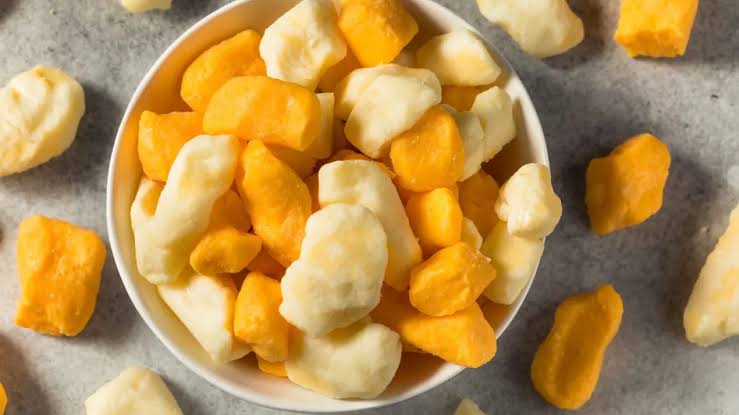
In Wisconsin, people often debate the merits of fresh vs. fried cheese curds. Battle lines are drawn, favorites are declared, arguments sometimes ensue. For the record, I like them both. If you can score fresh curds less than a day old, you’ll never look at cheese the same way again. Even bagged curds from the supermarket are excellent. Dozens of varieties are available, in flavors ranging from dill and ranch to hot buffalo and garlic and herb. Plain cheese curds are naturally white; annatto is often added for orange coloring, but the flavors are identical.
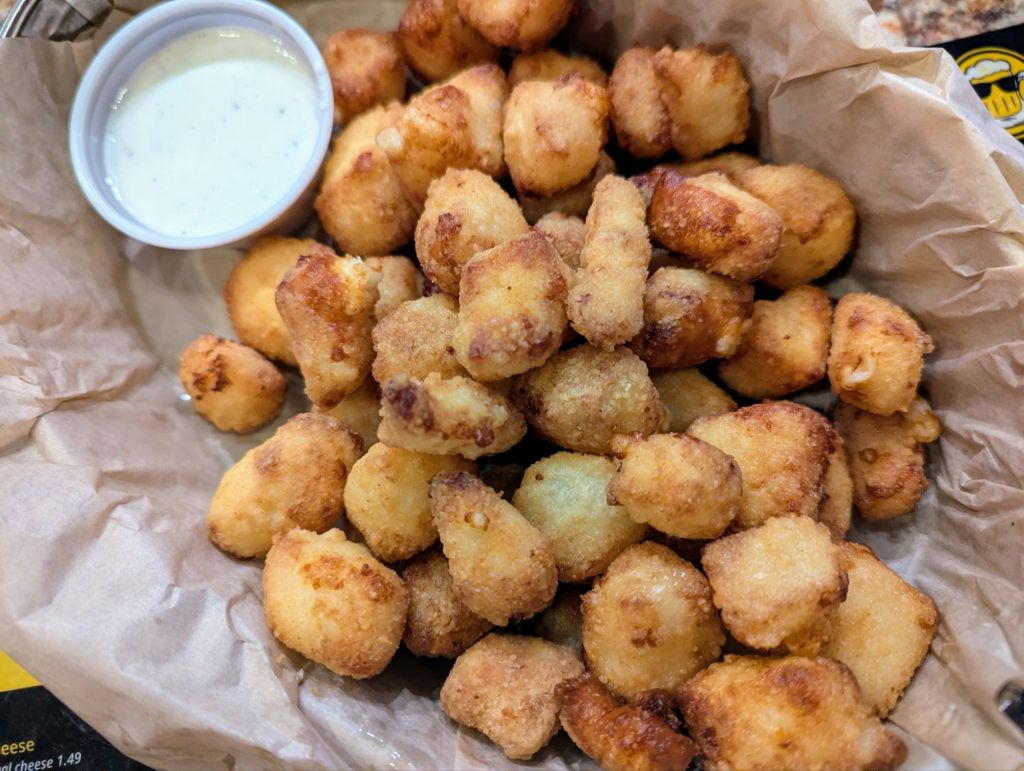
Fried cheese curds, though. There’s nothing like ’em. Whether they’re breaded or beer-battered, the crispiness of the coating intermingling with the silky tang of the gooey, melted cheese inside makes your taste buds sing. They’re downright addictive! And definitely not a health food, so moderation is key.
(Easier said than done sometimes.)
When my brother visited last year, we took him to The Old Fashioned. After a single bite, his eyes glazed over, and he remarked, “I’ll be chasing that cheese curd high forever.” He lives in Oregon, so he’s SOL. I’m luckier: virtually every restaurant, bar, and supper club in Wisconsin offers fried curds, and if not, there’s always the bowling alley, gas station, or convenience store. Calling them ubiquitous is an understatement.
The 5 Golden Cheese Curd Rules
I’ve tried a lot of fried cheese curds since moving to Wisconsin almost four years ago and have some very strong opinions about them.
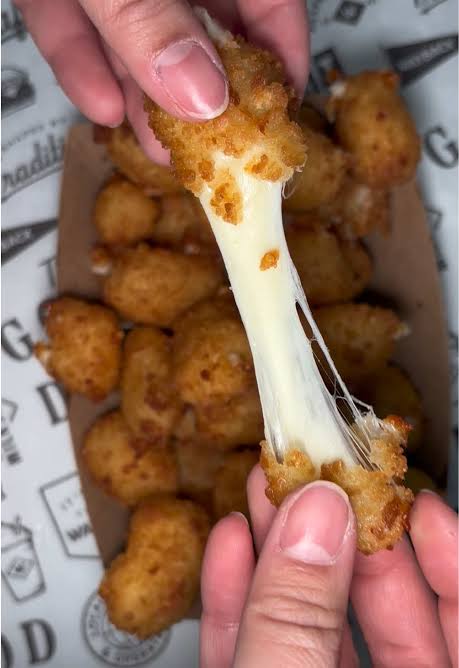
- The cheese pull is crucial; the longer the unbroken strand of melted cheese, the better the curd. Science backs this up: high-moisture cheeses, which tend to be freshest, create the longest strands. It’s become a game, seeing how far I can extend my hand from my mouth without breaking the strand.
- Cheese curds don’t have right angles. They should be small, lumpy, and irregularly shaped. Some places serve perfectly square “curds,” but this is false advertising: these are made from cut blocks of cheese, which occur during a later stage in the cheesemaking process. Are they tasty? Absolutely. Fried cheese will never not be good! But they aren’t true curds. Most are mass-produced and distributed by Water’s Edge in Chippewa Falls.
- Ranch dressing is the only acceptable dip. The creamy coolness of ranch perfectly complements the hot crispiness of the curd. And it had better be the good ranch! Sometimes, you’ll find marinara; save that travesty for mozzarella sticks (completely different). And don’t even try to pawn off some other fancy sauce, like honey mustard or raspberry jam. Fried curds are not meant for food snobs.
- The cheese-to-batter ratio must be precise. There’s nothing more disappointing than biting into a cheese curd and finding very little cheese inside. If the batter is too thick or the cook doesn’t shake off the excess, the cheese inside can melt too quickly and seep into the oil. Ideally, you want a thin batter so you get a mouthful of cheese. It’s no different than eating an onion ring that is missing the onion.
- Culver’s cheese curds are meh. I’m sorry, guys; I love your Butterburgers, your custard is divine, and you do amazing work supporting our local communities, but you really need to step up your curd game. It’s the one menu item that’s subpar. You’re representing Wisconsin on the national level. Please do better!
The Rating
OK, so there isn’t any particular brand or restaurant I’m rating: it’s just cheese curds in general.
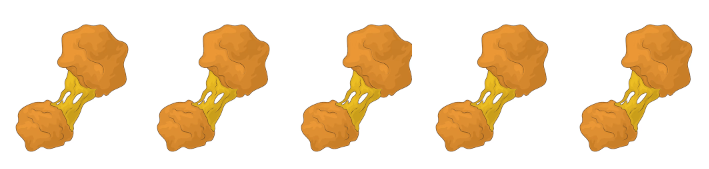
Anything less than 5/5 would be blasphemy. Fresh or fried, they’re one of nature’s most perfect foods!






 Mark My Words
Leave a comment