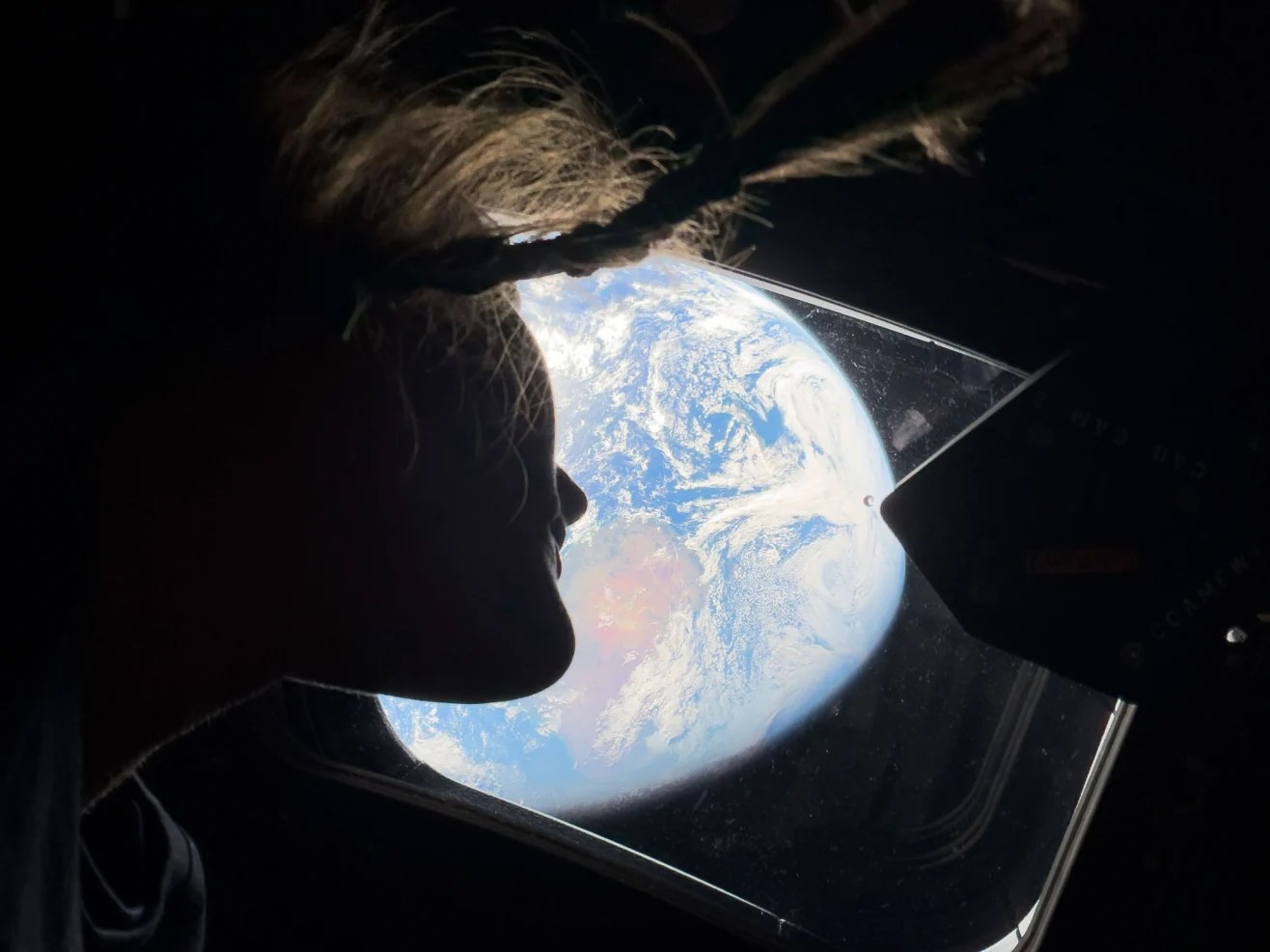
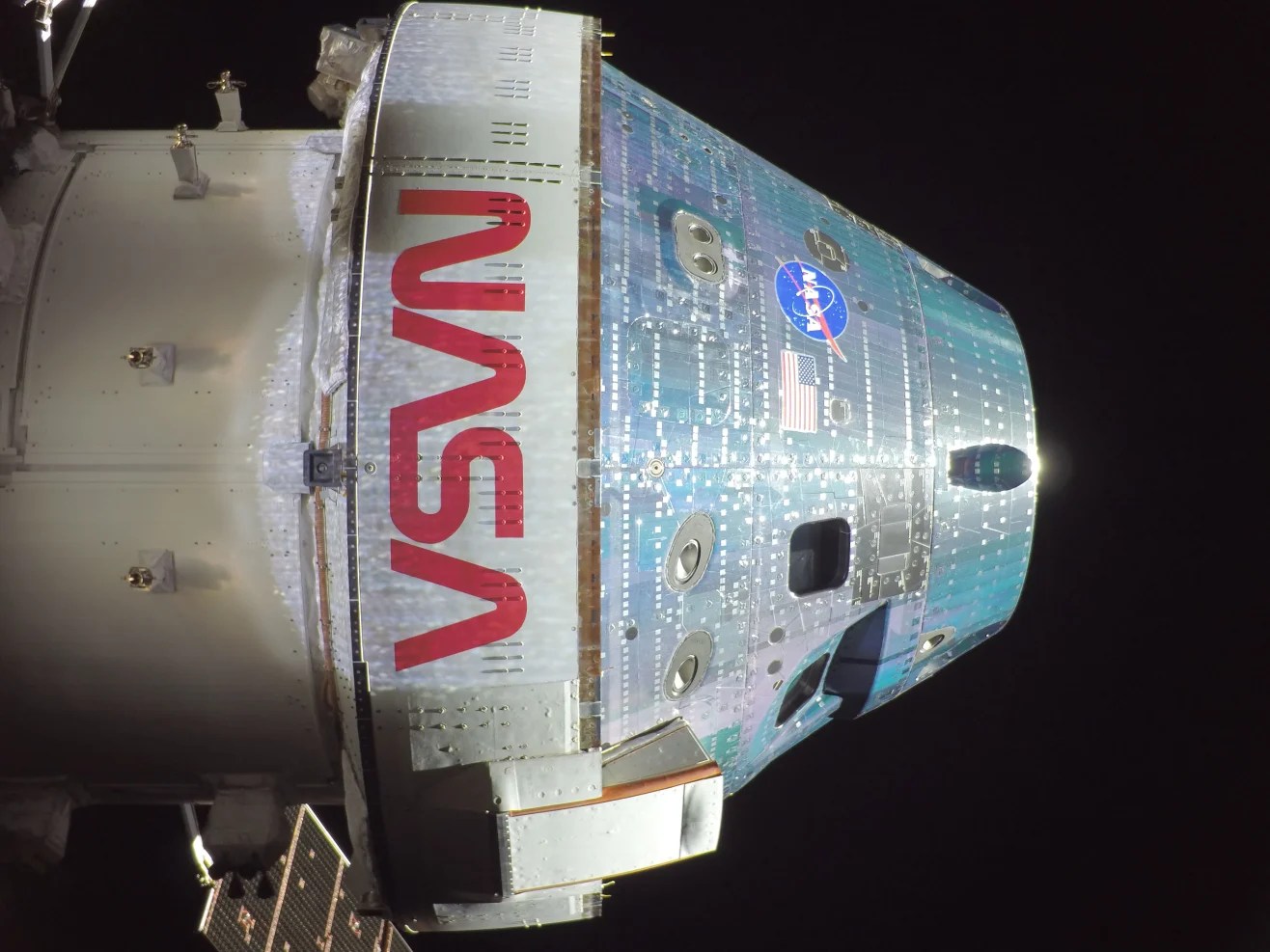
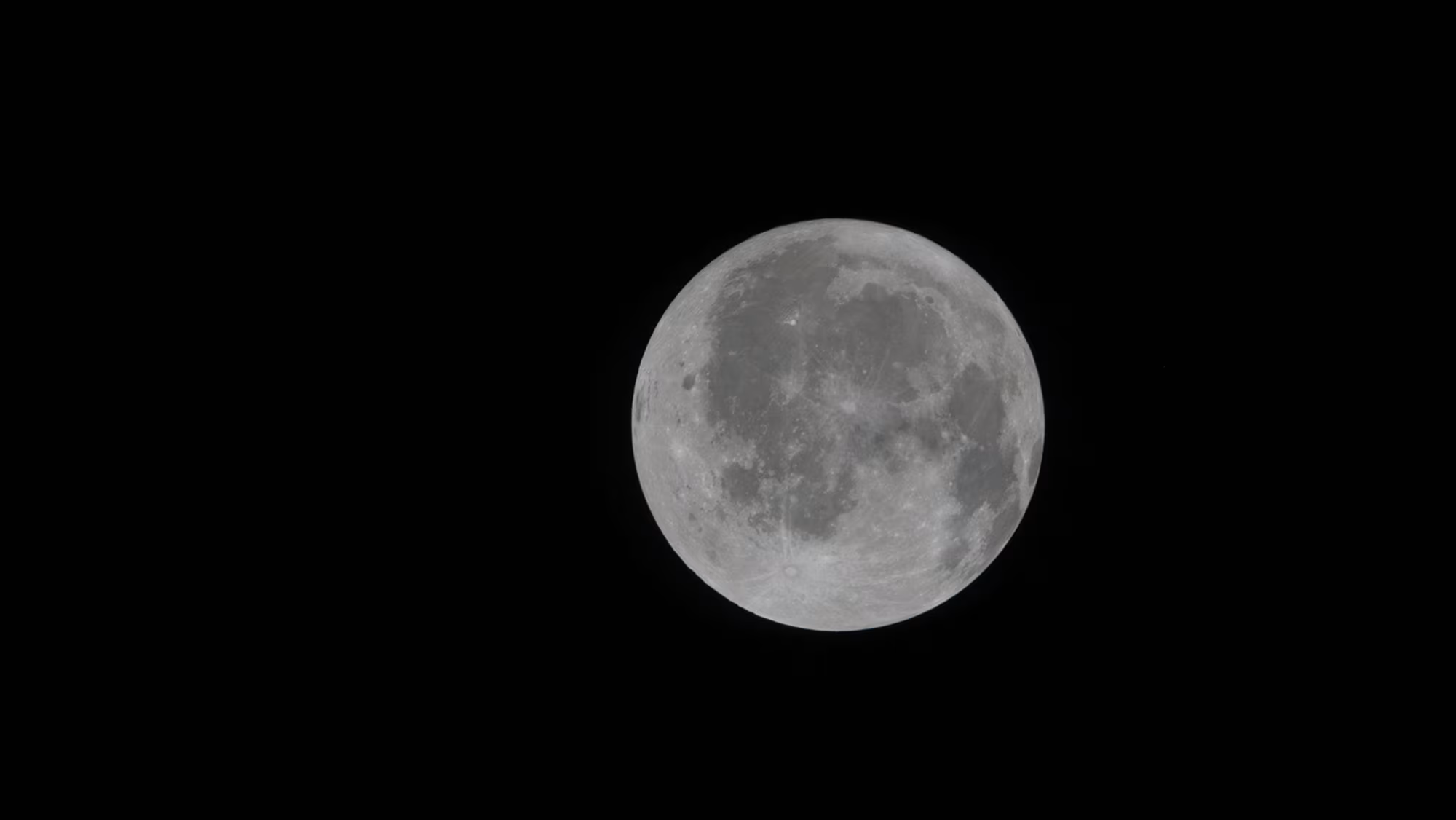
I don’t know if you realized this, but four human beings are currently crammed inside a small metal capsule hurtling through space at over 2,500 mph, Earth a tiny blue dot growing smaller by the second, two-thirds of the way to the moon on this Easter morning.
That is AMAZING. It gives me goosebumps.
As a child of the 1970s and ’80s, I was enraptured by spaceflight. Like many young boys, I dreamt of becoming an astronaut, the romanticism of zero gravity and Tang impossible to resist. Sadly, I can’t even board an airplane without freaking out over the slightest bit of turbulence, so needless to say, that career path never panned out.
Regardless, I was a huge fan of NASA’s space program, through all its triumphs and tragedies. Like so many of my Gen X peers, I witnessed the Challenger explosion live, distraught when the disaster unfolded on the portable TV my algebra teacher, Mr. Carpenter, had dragged into his classroom. But it didn’t dim my enthusiasm for spaceflight or the heroes who risked their lives in the name of exploration and discovery.
After moving to California for my senior year of high school, I had the privilege of interviewing Joseph Sousa, Milpitas High School’s MESA (Mathematics, Engineering & Science Achievement) advisor (and a Teacher In Space candidate) for my Journalism class. While Sousa didn’t make the final cut, he had flown to Florida in December 1985, where he met astronaut Fred Gregory. Sousa asked if the Challenger crew could take a MESA pin aboard the flight to represent the academic program geared toward educationally disadvantaged students and MHS’s academic commitments. Gregory was receptive to the idea, so Challenger astronaut Ron McNair sponsored the pin and carried it aboard the ill-fated flight. On Sept. 4, 1986, Sousa was notified that—amazingly—the pin had been recovered from the ocean floor amongst the Challenger wreckage and would be returned to him. He was so overcome with emotion, he had to leave his classroom, unable to continue that day’s lesson.
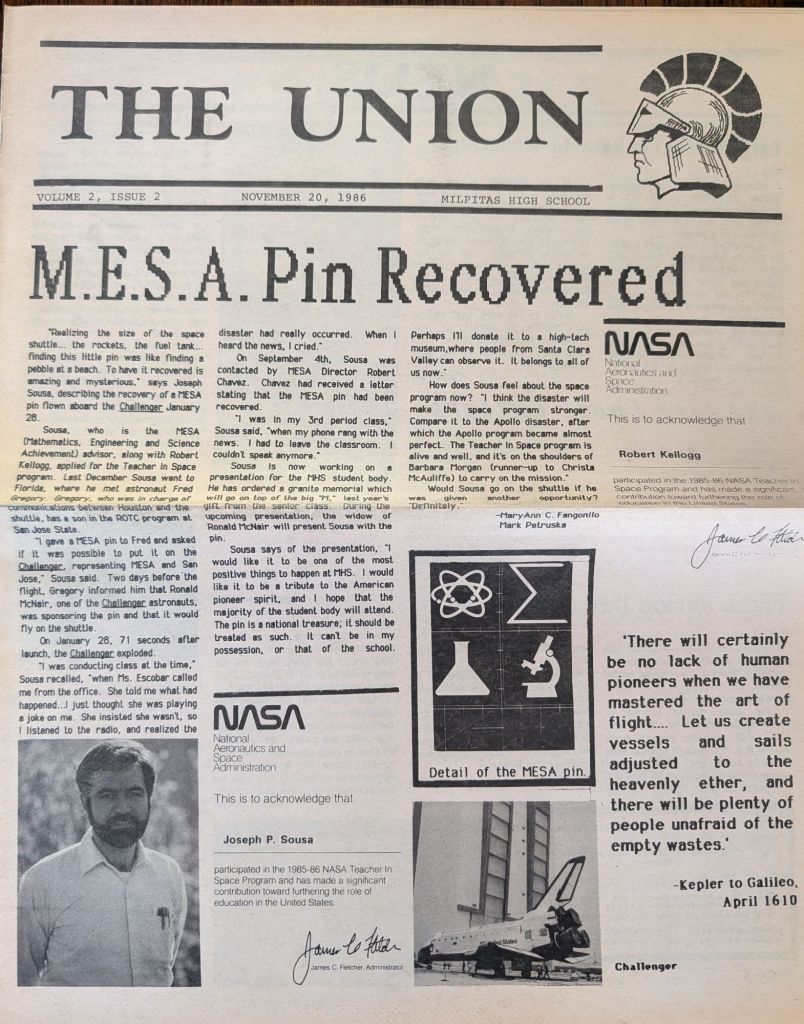
This was a huge deal for Milpitas High, and in fact, it made national news. I was extremely honored to write the story, which was nominated for a student journalism award (alas, I did not win). Sousa was confident the disaster would only make the space program stronger, and when I asked if he would fly aboard a future shuttle mission if given the opportunity, he didn’t hesitate for a second.
“Definitely.”
A few months later, astronaut David Walker presented the pin to Sousa during a school ceremony, in which my class unveiled its senior gift: a granite memorial to the Challenger crew. This was later placed in Milpitas HS’s Memorial Garden, erected the previous year in front of the school to honor the lost astronauts with seven trees—one for each each crew member. Sousa had the pin mounted on a plaque and displayed in MESA’s administrative office at San Jose State University, my alma mater.
All pretty cool stuff, huh? Decades later, I’m proud to have this small but not insignificant personal link to NASA and the Challenger. I’m extremely lucky to have known Joseph Souza and to have been involved with a permanent memorial that (presumably) greets students to this day. Is it any wonder my passion for the space program remains as strong as ever?
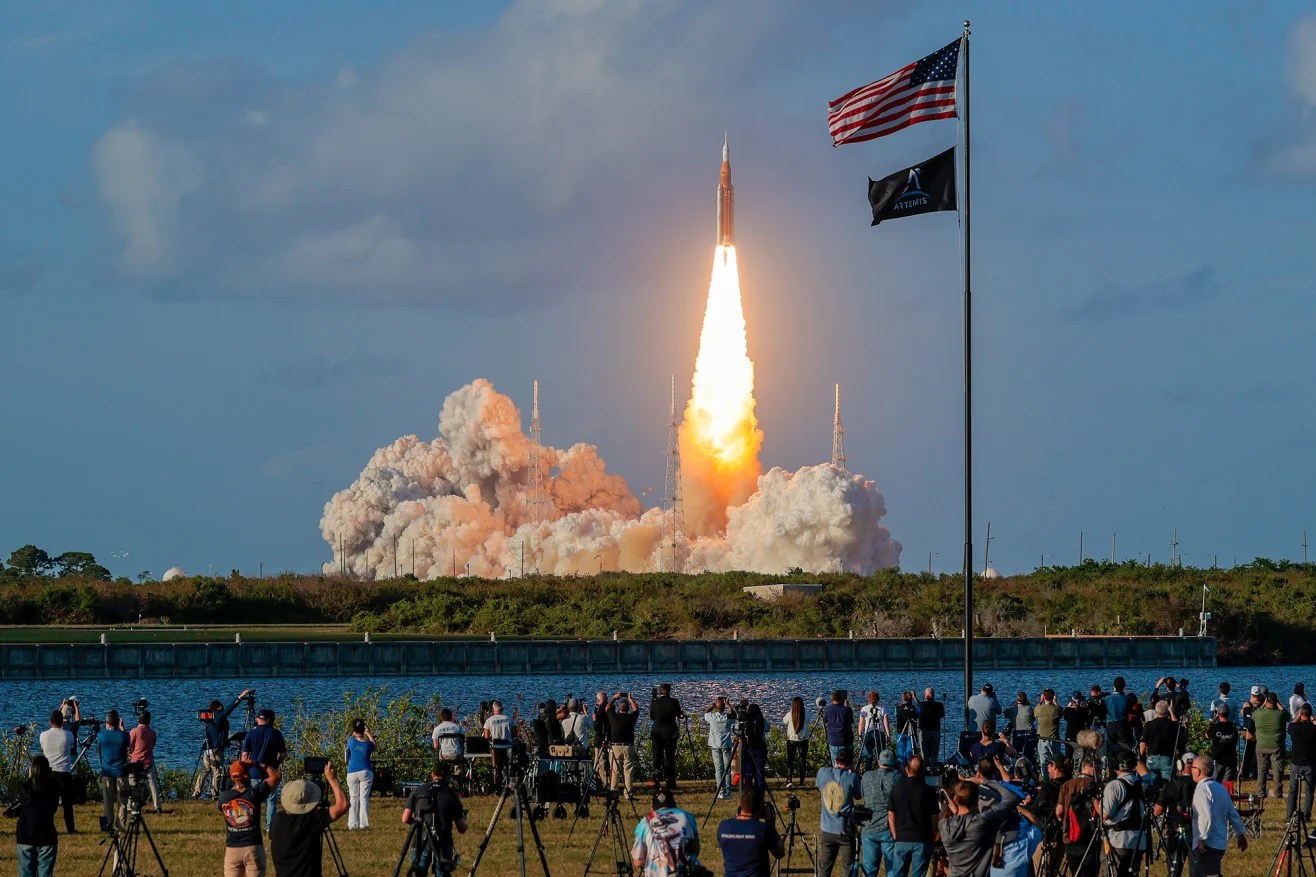
Which is why I have been following the Artemis II mission with unbridled zeal, reveling in the incredible photos, reading up on the crew’s daily schedules, right down to their meals and wake-up tunes, and visiting the Artemis II tracker, a nifty dashboard that provides up-to-the-moment flight information. I guess this makes me a space geek, but I am happy to embrace that. Critics say NASA is an overbloated agency, the money could be better spent on more pressing earthly matters, the whole thing is a distraction from the Epstein files, yadda yadda. I get it, but NASA’s budget of $25 billion makes up about .05% of the federal budget. That’s a drop in the bucket compared to the military, which receives $900 billion. Hey, here’s a thought: how about more moon missions and fewer senseless wars!
I’ll be the first to admit NASA is an imperfect agency. I recently finished Adam Higgenbotham’s excellent Challenger: A True Story of Heroism and Disaster on the Edge of Space and, good hell, the space shuttle was a ticking time bomb from the start; by nature of its design, it was much too risky to reliably transport humans to space and back. And NASA’s overly optimistic flight schedules were impossible to achieve; every delay was costly, which led to incredibly poor decision-making…and ultimately, the loss of the Challenger (and later, the Columbia.)
But space exploration is crucial for scientific knowledge and technological innovation. Without it, we wouldn’t have MRIs, CAT scans, ear thermometers, GPS, and water purification systems, among other inventions. It has helped us combat climate change, pollution, and loss of biodiversity, and has boosted global economies. It might ultimately be the catalyst to someday save humanity…if we’re not already too far gone by then.
“There will certainly be no lack of human pioneers when we have mastered the art of flight…let us create vessels and sails adjusted to the heavenly ether, and there will be plenty of people unafraid of the empty wastes.”
Kepler to Galileo, 1610
So, I will continue to champion the Artemis missions, following along with great interest, all of them—and when we land on the moon again in a couple of years, I’ll be cheering louder than almost anyone.
Will you?





 Mark My Words
Leave a comment