I first developed an appreciation for Old Fashioneds in South Dakota. There’s something about this classic cocktail that seems sophisticated, despite its simplicity: there are just three ingredients (whiskey/bourbon, bitters, sugar), plus an orange peel and cherry for garnish.
I don’t even remember the first time I ordered one. Whiskey sours were my gateway to the world of bourbon, I suppose; I’d enjoyed them for years. And then, at some point – maybe in Deadwood, where the allure of the Old West was especially strong; it was easy to imagine gold miners perched on barstools, knocking them back, partying like it was 1899 – I tried one out of curiosity and was instantly hooked. I’m not alone; Old Fashioneds consistently rank in the Top 3 of America’s favorite cocktails, depending on the study.
History of the Old Fashioned Cocktail
The Old Fashioned, true to its name, has been around a long time. Recipes date to the early 1800s, though it wasn’t given that name until 1880. The term “cocktail” was coined around 1806, and originally referred to any combination of spirits, bitters, sugar, and water. By the 1860s, cocktails were becoming more complex as bartenders added ingredients like orange curaçao, absinthe, Chartreuse, and other liqueurs. Some drinkers thought this was overkill, so they began asking for “Old-Fashioned Whiskey Cocktails” without all the embellishments, transforming a generic category into a specific drink.
And thus, a legend was born.
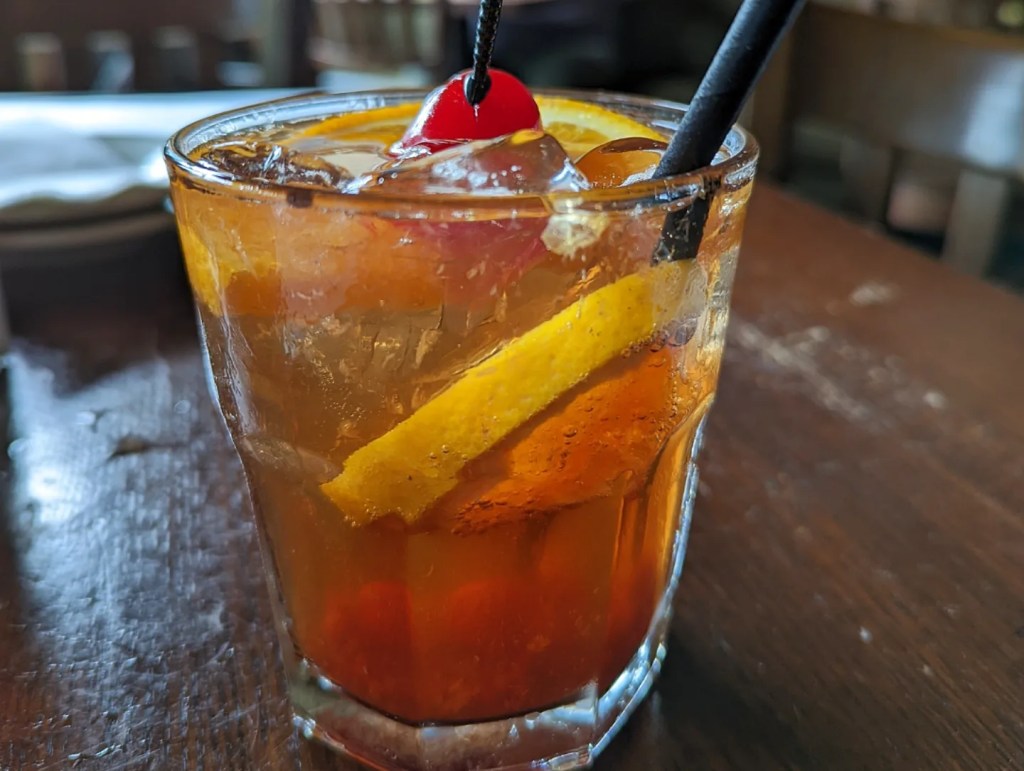
All Old Fashioneds, it turns out, are not alike. Wisconsin’s version utilizes brandy as the base spirit and is topped with a citrus-flavored soda. Depending on your preference, you can order it “sweet” (a lemon-lime soda, such as 7-Up or Sprite), “sour” (a grapefruit soda like Squirt, or sour mix), or “press” (a mix of half lemon-lime soda and half club soda to cut the sweetness). The classic garnish is a skewered orange slice and maraschino cherries, but in America’s Dairyland, nobody looks at you funny if you ask for olives or pickled mushrooms. Yes, this sounds weird, but trust me: it works.
Four California Brothers Travel to Chicago
Why is our Old Fashioned so different from the standard recipe? We need to fire up our virtual time machine and travel back to the 1893 World’s Columbian Exposition in Chicago for the answer. The Windy City was an easy train ride from Wisconsin, so many Sconnies took advantage of its proximity to attend the Chicago World’s Fair, as it was commonly referred to, that year. A large percentage happened to be German immigrants undoubtedly homesick for the Motherland.
The Chicago World’s Fair ran from May 1 to October 31, 1893. These expositions were huge deals back in the day and chock full of innovations. Chicago was no exception; notable firsts that year included the Ferris Wheel, books printed in Braille, moving walkways, and an electric car. Food and beverages were always big hits; fairgoers sampled new products like Juicy Fruit chewing gum, Quaker Oats, Shredded Wheat, Pabst Blue Ribbon, and Vienna beef hot dogs.
The Korbel brothers – Francis, Joseph, Anton, and Winsel – were California businessmen who’d discovered the Russian River Valley’s climate was ideal for winemaking, so they began producing finely handcrafted brandies. Eager to expand their sales, they headed east to the World’s Fair in 1893. Their brandy was such a hit with German immigrants – the smooth, mellow spirit reminded them of the fruit-forward schnapps and distillates they’d appreciated in their homeland – that they brought it back to Wisconsin by the caseload.
Prohibition, World War II, and the Rise of Brandy
A few decades later, Prohibition was enacted. With good liquor no longer available legally, people turned to moonshine and other bathtub spirits, which were less palatable. This is really just a fancy way of saying they tasted like shit. To improve the flavor, bootleggers began adding fruit and sugar to the swill. This habit stuck even after Prohibition was repealed.
Brandy is dandy, but up until the 1940s, Wisconsinites still enjoyed their Old Fashioneds with whiskey like everyone else. But then World War II arrived and many distilleries closed down when the grain was sent overseas to assist with the war effort. The only booze available was made on the cheap and inferior in quality. That’s when some 30,000 barrels of Korbel brandy were discovered. Tavern owners learned that, when faced with a choice between bad bourbon and good brandy, patrons preferred the latter. And the rest, as they say, is history.
At least that’s how the legend goes. Is it entirely true? Probably not. There’s always a good bit of romanticizing tales like these. However, one thing is undeniable: Wisconsinites consume more brandy than any other state by a wide margin, and Korbel is king. In 2019, the company produced 275,000 cases of brandy, and over half (150,000 cases) were sold in the Badger State alone. Most of it, of course, serves as the base spirit in the Brandy Old Fashioned, which a bipartisan resolution named the official state cocktail in 2023.
Love at First Sip
I knew the legend of the Brandy Old Fashioned but had never tried one until we visited Madison in July 2022. It was love at first sip: mellow, fruity, and subtle, with a pleasantly sweet flavor that lingers on the palate. Much less biting than the whiskey-based version I’d been enjoying. In that blog post, I wrote, I don’t know if I can ever go back to whiskey again.

And for the most part, I have not. I don’t drink them all the time, but when I do order an Old Fashioned, 95% of the time it’s going to be made with brandy. I might make an exception if we’re visiting a distillery that produces its own bourbon, like Driftless Glen in Baraboo, but otherwise I never stray. I’ve refined my order over the years; nowadays, my go-to is a Brandy Old Fashioned press with olives. The words spill forth from my mouth naturally, like I’ve been ordering this cocktail my whole life, instead of just the past three years.
During that 2022 visit, I found several brands of canned Brandy Old Fashioneds for sale. By that point we knew we wanted to move to Wisconsin but had no idea how long that would take (spoiler: not long at all!), so I stocked up and brought a bunch back with me.
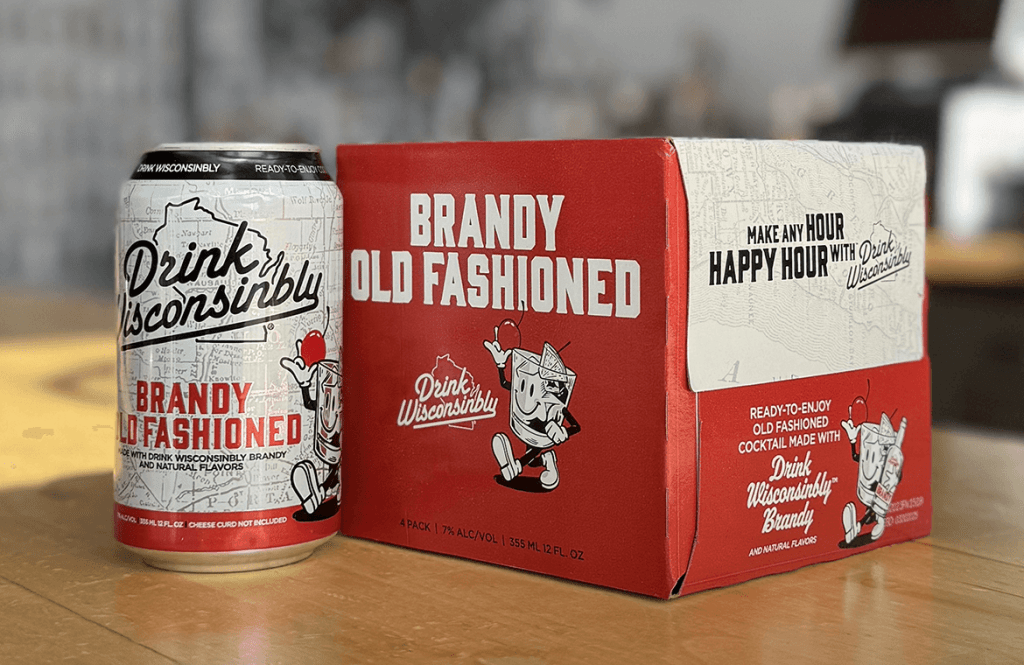
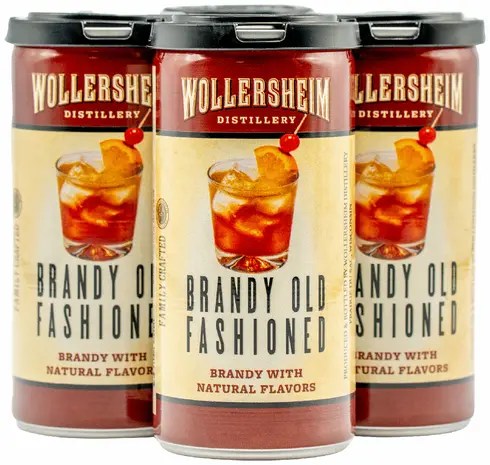
While convenient, you don’t really need to buy them pre-made unless you’re looking for portability (e.g., a picnic or kayaking). They’re simple (and cheaper) to make at home. It took a little trial and error, but with a few tweaks here and there, I eventually came up with a recipe perfectly suited to my tastes. Honestly, it’s every bit as good as any I’ve ordered in a bar or supper club. I’m sharing in case you want to try one at home. Tweak as you like; Jolly Good is unique to Wisconsin, but 7-Up, Sprite, or Squirt will all work. If the thought of a blue-cheese stuffed olive grosses you out, skip it…but keep an open mind. The first time a server offered me this option I was convinced that was a bridge too far, but the salty, savory olive perfectly complements the sweeter beverage.
Midwest Mark’s Brandy Old Fashioned Press
INGREDIENTS
2 oz. brandy (preferably Korbel)
1 sugar cube
Dash Angostura bitters
2 orange slices
2 maraschino cherries
1 large green olive, plain or blue cheese stuffed (optional)
1 can Jolly Good Diet Sour Pow’r (or sweet/sour soda of your choice)
1 can club soda
DIRECTIONS
Place a sugar cube in the bottom of a rocks glass and add a dash of bitters. Top with an orange slice and a maraschino cherry and muddle to extract the flavors. Add brandy and a generous portion of ice, followed by equal parts sweet/sour soda and club soda. Stir to combine, garnish with an olive, orange slice, and a maraschino cherry, and thank the Korbel brothers for attending the 1893 Chicago World’s Fair.


 Mark My Words
Leave a comment